01 / Missing
A DPP field gap is found
The manufacturer sees a passport draft blocked by missing supplier-held evidence, not an abstract compliance checklist.
Gap: recycled content evidence
Product scopeDPP versionRequired fieldDue date
Redy shows the operational chain competitors often hide: the missing field, supplier request, source evidence, human review, versioned record, and passport-ready output.
Missing, requested, submitted, approved, versioned, published.
The supplier owns source evidence and grants, not just an upload box.
AI and OCR can propose values; authorized reviewers decide what commits.
Approved evidence can feed portal views, APIs, exports, and public passport surfaces.
Every claim Redy publishes moves through the same evidence chain. Each state names who acted and what artifact changed — so any published value can be traced back.
A required passport field has no trusted value yet.
The gap becomes a scoped supplier evidence request.
The supplier attaches source documents and values.
A reviewer commits the value from the evidence.
The approved claim becomes an immutable record.
Feeds passport views, APIs, exports, and resolvers.
This is the chain buyers should ask every DPP vendor to explain. Redy makes each state explicit so teams can see who acted, what evidence changed, and what became publishable.
The manufacturer sees a passport draft blocked by missing supplier-held evidence, not an abstract compliance checklist.
Redy turns the gap into a targeted supplier ask with product context, requested fields, and the reason the evidence is needed.
The supplier attaches source documents, reviews extracted values, and decides what can be shared for the request.
The manufacturer reviews the proposed claim, source context, confidence, and supplier grant before it enters a passport record.
The approved value is tied to source evidence, actor trail, grant state, and DPP version instead of becoming a naked spreadsheet cell.
The approved record can support public passport pages, API consumers, exports, resolver paths, and downstream consumer views.
The difference between a weak DPP page and a trustworthy DPP workflow is the metadata that survives review and publication.
The reviewed DPP field value, not a raw attachment name.
The supplier record and document context behind the value.
The permission boundary that explains why this buyer can use it.
The human decision state before the claim becomes publishable.
The passport version that consumed the approved evidence.
The same reviewed record can feed multiple downstream surfaces.
{
  "claim": "recycledMaterialPercentage",
  "value": 42,
  "unit": "percent",
  "status": "manufacturer_approved",
  "supplierEvidence": {
    "recordId": "evidence_rec_42",
    "supplierOrg": "Northline Apparel",
    "source": "recycled-polyester-declaration.pdf",
    "attestation": "supplier_confirmed"
  },
  "grant": {
    "scope": "JACKET-TS-2408",
    "consumer": "manufacturer_org_18",
    "state": "active"
  },
  "passportVersion": "dpp_v1_0",
  "auditRef": "audit_evt_927"
}Who can create the request?
Manufacturer workspace users with request authority.
Any teammate emails every supplier the same spreadsheet.
Who owns the source evidence?
The supplier workspace maintains source files, records, grants, and reuse decisions.
The manufacturer copies files into a private folder and loses supplier context.
When does AI become truth?
Never by itself. AI output stays proposed until authorized review confirms it.
Extracted values are pasted into a passport without source review.
What survives publication?
Source references, review state, grant metadata, version id, and audit trail.
A public DPP page shows claims but cannot explain how they were approved.
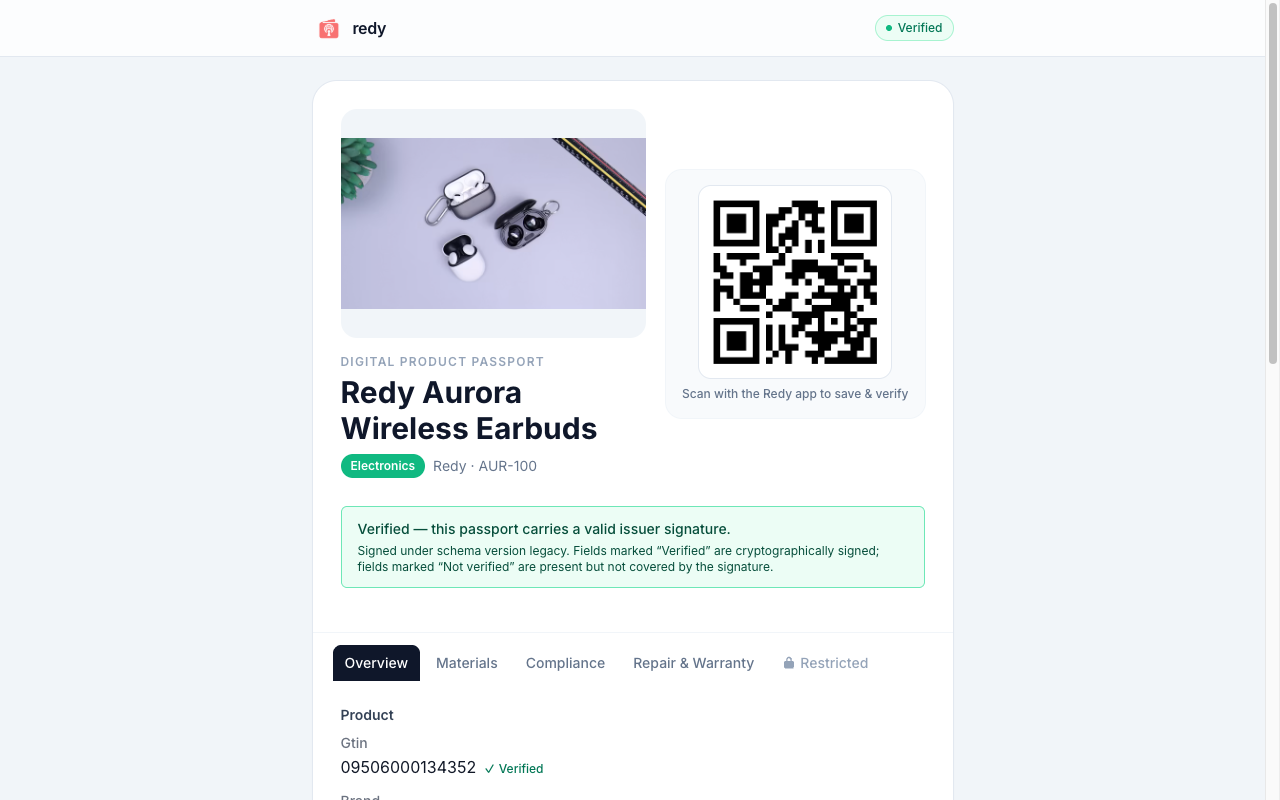
The published Digital Product Passport as consumers see it: verified issuer signature, signed-field markers, and the QR resolver link.
The proof is not a single mock screen. It is the same governed record moving through manufacturer, supplier, public, and integration surfaces.
Teams see missing fields, supplier requests, approvals, and blocked publication states.
Suppliers preserve documents, extracted values, and grant choices for future requests.
Consumers and buyers see useful passport facts without exposing private workroom data.
Approved records can move to PLM, PIM, ERP, LCA, and external DPP platforms.
Ask every provider how a missing supplier field becomes a reviewed, versioned, revocable, exportable passport claim.