01
Map missing DPP fields
Import or create product records, then separate manufacturer-owned data from supplier-held evidence requirements.
Redy is built around the work behind every credible Digital Product Passport: missing fields, supplier evidence, review decisions, provenance, versioned publication, and system outputs.
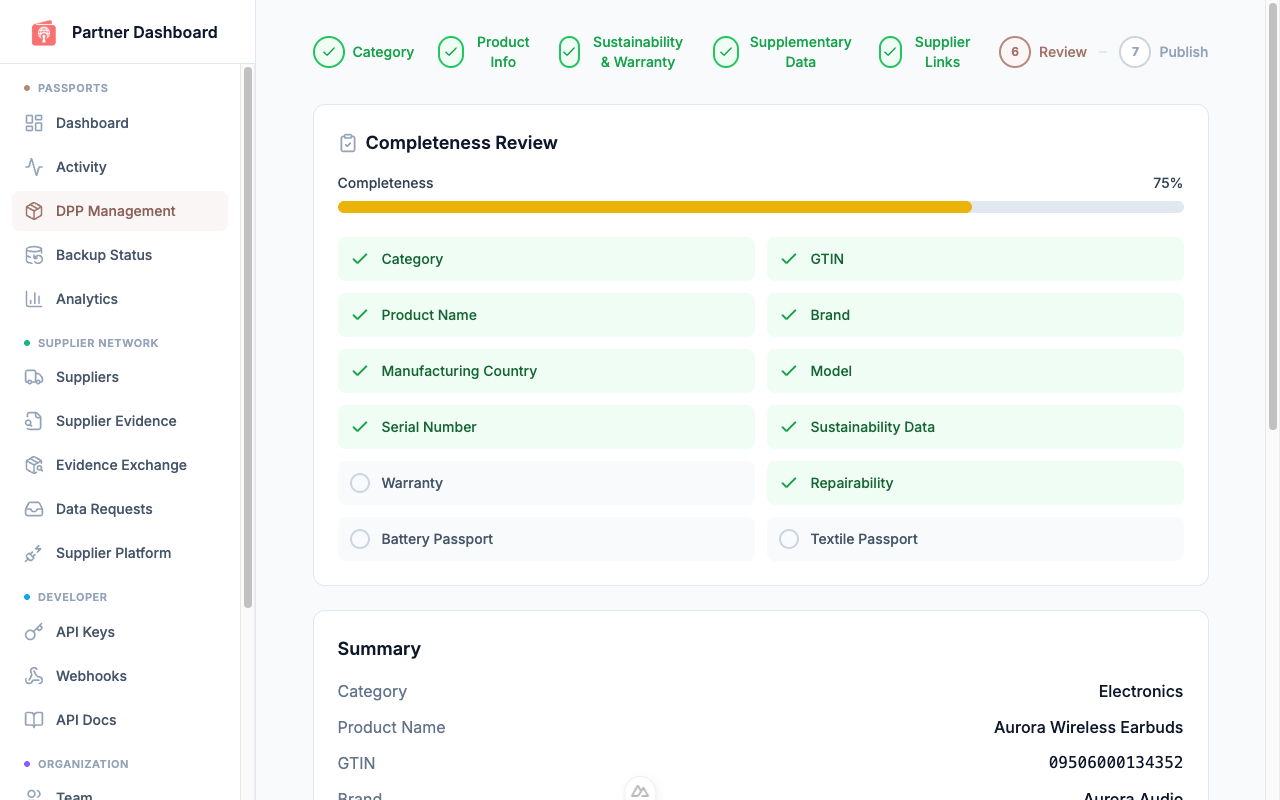
The DPP creation workflow's completeness review: a field checklist and completeness bar showing exactly what is present and what is still missing before publication.
Redy is not a pile of disconnected modules. Each feature exists to move data from uncertainty to approved, explainable passport claims.
Import or create product records, then separate manufacturer-owned data from supplier-held evidence requirements.
Send suppliers focused requests with product context, field requirements, attachments, and due dates.
Use AI-assisted extraction for certificates, declarations, and LCA attachments while keeping reviewer control.
Review values, source documents, confidence, supplier grants, and audit context before data enters a passport.
Move approved claims into DPP views, APIs, webhooks, exports, and resolver-ready records with provenance attached.
Track required fields by product group, product record, supplier, and passport version so missing evidence is visible before publication.
Convert missing fields into scoped supplier requests instead of email threads and spreadsheet tabs.
Collect declarations, certificates, audit letters, LCA extracts, and structured values with source context intact.
Use AI to accelerate evidence parsing while keeping confidence, source text, and reviewer decisions visible.
Approve, reject, request changes, and preserve who made each decision before any value becomes passport data.
Keep actor, timestamp, evidence, grant, version, and source context attached to every approved claim.
Publish controlled passport versions and keep downstream surfaces aligned as records change.
Connect the evidence workflow to product systems, supplier portals, analytics, and resolver implementation paths.
Let suppliers respond once and reuse approved evidence across requests with permission and context attached.
Manufacturers, suppliers, compliance reviewers, and IT teams should not fight over separate copies of the same DPP data. Redy keeps one workflow with role-aware surfaces.
Owns readiness, review, approval, publication, revocation, and DPP issuer actions.
Responds to scoped requests, attaches evidence, reviews extracted values, and controls reuse grants.
Reviews source evidence, decision state, actor attribution, version history, and published outputs.
Connects Redy to product systems, supplier data sources, exports, webhooks, and resolver paths.
DPP teams need speed, but they also need defensible decisions. Redy treats AI as an assistive layer inside a governed review workflow.
See AI detailsExtracted from supplier declaration, pending manufacturer approval.
Redy should not force a manufacturer to replace product systems. The feature set connects around those systems and keeps the DPP workflow explainable.
No. The consumer view is only one output. This page focuses on the operational features manufacturers and suppliers need before a passport can be trusted.
Yes. Supplier response is free. Manufacturers pay for the governed workflow that controls readiness, approvals, publication, integrations, and reporting.
No. AI can extract and normalize evidence, but Redy keeps confidence, source context, and reviewer approval state visible before publication.
The evidence workflow is domain-flexible: request evidence, review claims, preserve provenance, and publish versioned outputs as official schemas mature.
Supplier response stays free. Manufacturer workspaces control approval, publication, integrations, and audit-ready outputs.